
April 1, 2026
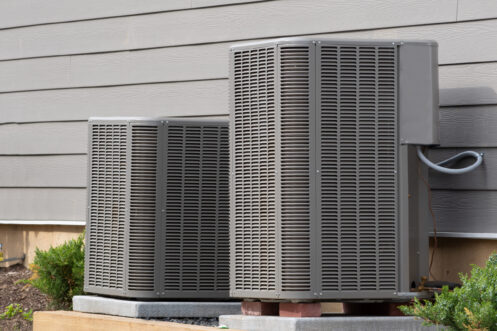
If your St. Louis, MO, home needs a new AC system, you’ll have plenty of selection options. There are numerous quality manufacturers and an endless number of models with varying features. However, regardless of which model you ultimately choose, there’s one thing you can’t afford to get wrong: your AC’s size. Here’s what you need to know about AC sizing and how to choose the right size AC for your space.
Why Does AC Size Matter?
When most homeowners think about AC sizing, they worry about choosing a system with sufficient cooling capacity. After all, if an AC can’t keep you cool, what good is it? However, many homeowners don’t understand that an AC that’s too big for their home is just as problematic.
An AC that’s too small will obviously struggle to cool your home. As a result, it will run continuously, wasting energy and having accelerated wear and tear. Meanwhile, an AC that’s too large will have the opposite problem. It will cool your home too quickly, leading to short cycling, which is an AC that turns on and off rapidly. Believe it or not, that’s almost more damaging to your AC than if it ran continuously. Plus, an AC draws more electricity at startup than while running. So, an oversized AC will waste energy and increase your utility bills. It may also struggle to remove sufficient humidity from your home’s air, which can harm your comfort.
How AC Sizing Works
If you’ve ever gone shopping for window ACs, you may have seen their capacities described in BTUs. That stands for British thermal units. They’re a standard heat measurement. An AC’s BTU rating tells you how much heat it can remove from a given space in one hour. In general, most homes require 20 to 25 BTUs per square foot to cool efficiently.
Unfortunately, central ACs don’t come in sizes measured by BTUs. Instead, they use a unit called a ton. The good news is that one ton equals 12,000 BTUs, so it’s relatively straightforward to convert between the two scales. A 3-ton central AC, for example, will deliver 36,000 BTUs of cooling capacity. It’s also important to understand that central ACs come in half-ton size increments. So, you may not find a system with the exact capacity you need. The rule of thumb is to always round up to the nearest half ton to ensure you get enough capacity.
The following are some of the most common central AC sizes and how many square feet they can cool:
- 1.5 tons cools 600-900 square feet
- 2 tons cools 901-1200 square feet
- 2.5 tons cools 1201-1500 square feet
- 3 tons cools 1501-1800 square feet
- 3.5 tons cools 1801-2100 square feet
- 4 tons cools 2101-2400 square feet
- 5 tons cools 2401-3000 square feet
Estimating Your AC Size Needs
It’s worth pointing out that you can only come up with a rough estimate of your home’s AC size needs. Countless factors go into calculating a home’s exact heat load. A rough estimate, however, begins with calculating your home’s square footage. Once you have it, multiply the figure by 25, and then divide by 12,000. That should tell you roughly what size central AC, in tons, your home needs.
If you want to refine your estimate, there are some additional factors you can consider. They include things that may increase your home’s heat load. For example, if you have a large family, your home’s cooling requirements will increase, so add 100 BTUs to your calculation for each family member. Your home’s windows also contribute to its cooling needs. Window quality varies, but it’s safe to add 1,000 BTUs for each window for estimating purposes. The same applies to each exterior door in your home.
The height of your home’s ceilings can also affect its cooling needs. The average ceiling height in a home is 8 feet. If you have rooms with higher ceilings than that, you must account for them. Add 1,000 BTUs for each extra foot of ceiling height. Then, turn your attention to your home’s kitchen. It’s a major heat source in the average home. If you have a small kitchen that you use occasionally, add 1,200 BTUs to your total. For a large, frequently used kitchen, add 2,400 BTUs instead.
The Professional AC Sizing Process
Estimating your home’s AC sizing needs is fine when you first begin shopping. However, it’s essential to let an HVAC professional evaluate your home before making a purchase. They’ll conduct a Manual J calculation for your home. Manual J is a guidebook produced by the Air Conditioning Contractors of America (ACCA). It will have a detailed heat load evaluation process and other information about factors that influence residential heat loads.
A Manual J calculation begins much like a rough estimate. It starts with square footage and the same heat load factors mentioned above. However, it also considers a variety of other things that a rough estimate wouldn’t. For example, a professional HVAC contractor will evaluate your home’s insulation and air seal quality. That lets them know how much or how little heat may enter your home from outside. Higher-quality insulation reduces your AC needs, and vice versa. Manual J also offers guidelines for different climate zones and humidity guidelines.
A professional HVAC contractor will also consider factors like your home’s orientation and solar exposure. Plus, they’ll evaluate your home’s ductwork before completing their calculations. In some cases, they may recommend duct sealing if necessary to avoid unnecessary AC oversizing.
A Word on AC Replacement Sizing
At this point, many homeowners ask why they can’t simply use their existing AC’s size as a guide. You can do that instead of creating your own rough estimate. However, you’ll still want a qualified HVAC contractor to complete a Manual J calculation before replacing your AC. That’s especially important if your home came with an AC installed by a previous owner. You have no way to know who installed your AC or whether they performed a proper Manual J calculation. Since a new AC is a big investment, you shouldn’t take any chances by cutting corners. We wouldn’t even agree to replacing your AC without evaluating your home ourselves, for your protection.
The AC Leader in St. Louis
For over 45 years, Scott-Lee Heating Company has been the top air conditioning service in St. Louis. We’re members of the ACCA and a Lennox Premier Dealer. Plus, all our HVAC technicians hold NATE certification, making them among the best in the business. We’re also Better Business Bureau accredited and have an A+ rating. We even offer financing options on approved credit if you need help affording a new AC installation. So, when you need a new AC for your St. Louis home, contact Scott-Lee Heating Company right away!